> > India >> States >> Uttar Pradesh
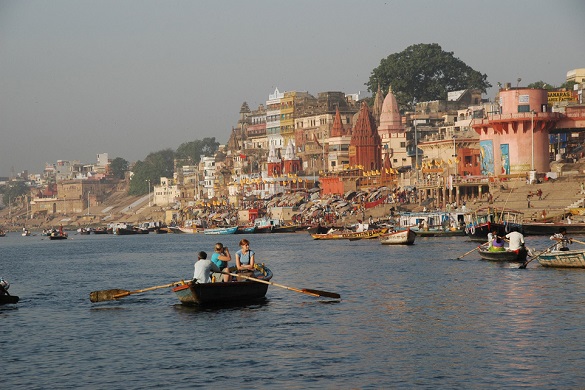
Varanasi, also known as Banaras, is a historic city located on the banks of the Ganges River in Uttar Pradesh. It is considered one of the oldest continuously inhabited cities in the world and holds immense religious importance in Hinduism and Jainism. The city also played a significant role in the development of Buddhism and the Bhakti movement.
Varanasi is one of the largest cities in Uttar Pradesh and an important religious and cultural center in northern India. With a population of over 1.4 million, it is the sixth-largest city in Uttar Pradesh. As per the provisional reports of the Census of India 2011, the population of Varanasi city was 1,198,491 (11.98 lakh).
👉 Estimated Population of Varanasi in 2026: ~16 lakh
Varanasi City Population (2011 vs 2026)
| Varanasi City | Census 2011 | 2026 Estimate |
|---|---|---|
| Total Population | 1,198,491 | 16 lakh |
| Male Population | 635,140 | 8.40 lakh |
| Female Population | 565,351 | 7.60 lakh |
Varanasi City Demography
| Indicator | Value |
|---|---|
| City Area | 82.10 sq. km |
| Population Density | 14,600 per sq. km |
| Average Literacy Rate | 79.27% |
| Male Literacy | 83.46% |
| Female Literacy | 74.55% |
| Sex Ratio | 887 |
| Child Sex Ratio | 883 |
| Children (0–6 years) | 135,667 |
Sources: Census 2011
Varanasi Historical Population
According to the 2011 Census, Varanasi recorded a population growth rate of 8.56% during 2001–2011. The growth rate has slowed in recent decades compared with the rapid urban expansion seen in the late 20th century.
At the beginning of the 20th century, Varanasi had a population of around 2.15 lakh and remained relatively stable until the 1940s. After independence, the city experienced steady urban growth and crossed 1 million population by 2001.
| Year | Population | Actual Change | % Change |
|---|---|---|---|
| 1901 | 215,223 | – | – |
| 1911 | 205,420 | -9,803 | -4.55% |
| 1921 | 200,022 | -5,398 | -2.63% |
| 1931 | 203,372 | 3,350 | 1.67% |
| 1941 | 262,838 | 59,466 | 29.24% |
| 1951 | 351,234 | 88,396 | 33.63% |
| 1961 | 485,083 | 133,849 | 38.11% |
| 1971 | 598,020 | 112,937 | 23.28% |
| 1981 | 728,511 | 130,491 | 21.82% |
| 1991 | 943,907 | 215,396 | 29.57% |
| 2001 | 1,103,952 | 160,045 | 16.96% |
| 2011 | 1,198,491 | 94,539 | 8.56% |
| 2021 (Est.) | 1,410,000 | 211,509 | – |
Sources: Census 2011
Varanasi District Population
Varanasi district is located in eastern Uttar Pradesh, with Varanasi city serving as the district headquarters. According to the 2011 Census, the district has a population of 3,676,841. The district recorded a population growth rate of 17.32% between 2001 and 2011 and has a population density of 2,399 persons per sq. km.
Around 43.44% of the district’s population lives in urban areas.
Estimated Population of Varanasi District in 2026: ~42 lakh
| Indicator | Census 2011 |
|---|---|
| Total Population | 3,676,841 |
| Male Population | 1,921,857 |
| Female Population | 1,754,984 |
| Literacy Rate | 75.60% |
| Sex Ratio | 931 |
| Child Sex Ratio | 885 |
Religion in Varanasi District
| Religion | Percent |
|---|---|
| Hinduism | 84.52% |
| Islam | 14.88% |
| Other / Not Stated | 0.60% |
Languages Spoken in Varanasi District
At the time of the 2011 Census:
| Language | Percent |
|---|---|
| Hindi | 76.2% |
| Bhojpuri | 19.7% |
| Urdu | 3.24% |
| Others | 0.89% |
Bhojpuri is widely spoken in the Varanasi region along with Hindi.
Key Takeaways: Varanasi Population
• Estimated population of Varanasi city in 2026 is around 16 lakh, up from 11.98 lakh in the 2011 Census.
• Varanasi is the sixth-largest city in Uttar Pradesh by population and one of the oldest continuously inhabited cities in the world.
• The literacy rate of Varanasi city is 79.27%, with male literacy at 83.46% and female literacy at 74.55% according to the Census of India 2011.
• The sex ratio in Varanasi city is 887 females per 1000 males, slightly below the national average.
• The population of Varanasi district is estimated to reach around 42 lakh by 2026, reflecting the broader urban region beyond the municipal city limits.
Note on City vs District Population
In many Indian cities, municipal limits cover only the core urban area, so the official city population may appear smaller than the real urban population. In such cases, the district population often provides a better reflection of the broader urban region, as Census city limits and Urban Agglomeration definitions may not fully capture the actual city spread.
Know more about Uttar Pradesh

Pingback:Population of India 2022 | Demography of India | Find Easy