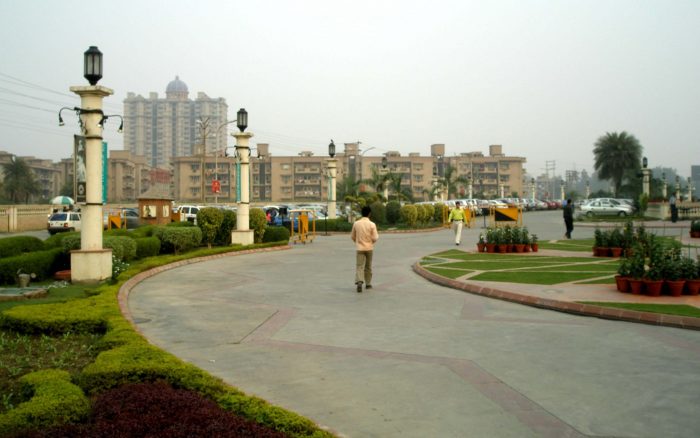
Population of Ghaziabad

Ghaziabad is one of the largest and fastest-growing cities in the Indian state of Uttar Pradesh. Located just east of Delhi, the city forms an important part of the National Capital Region (NCR) and functions as a major residential and industrial hub for the Delhi metropolitan area.

According to the 2011 Census of India, the population of Ghaziabad city was 1,648,643 (16.48 lakh), making it one of the most populous urban centers in western Uttar Pradesh. Rapid urbanization, migration, and proximity to Delhi have contributed to the city’s strong population growth in recent years.

👉 Projected Population of Ghaziabad in 2026: ~22 lakh (2.2 million)

Note: In many Indian cities, municipal boundaries cover only the core urban area.

Census 2011 vs 2026 Estimate

Ghaziabad CityCensus 20112026 Estimate
Total Population1,648,643 (16.48 Lakh)~22 Lakh
Male Population874,607~11.6 Lakh
Female Population774,036~9.4 Lakh
Average Literacy Rate84.78%
Sex Ratio885
Child Sex Ratio835

Religion in Ghaziabad City

Hinduism is the dominant religion in Ghaziabad city, with over four-fifths of the population identifying as Hindu. Islam is the second largest religion, while smaller communities include Sikhs, Christians, Jains, and Buddhists.

ReligionPercentage
Hindu82.50%
Muslim14.18%
Sikh0.96%
Christian0.78%
Jain0.71%
Buddhist0.15%
Others0.01%
Not Stated0.71%

Ghaziabad District Population

Historically, Ghaziabad district included Ghaziabad city, Modinagar, Hapur, and Garhmukteshwar as its main subdivisions. However, on 28 September 2011, Hapur district (Panchsheel Nagar) was carved out from Ghaziabad, after which the population figures for the district were revised.

According to the 2011 Census, the population of Ghaziabad district after the split was 3,323,241 (33.23 lakh).

👉 Estimated Population of Ghaziabad District in 2026: ~40 lakh

Ghaziabad DistrictCensus 2011
Total Population3,323,241 (33.23 Lakh)
District Area1,034 sq. km
Population Density~3,200 per sq. km
Average Literacy Rate~85%
Sex Ratio878

Source: Census of India 2011

Note: In many Indian cities, official municipal boundaries cover only the core urban area, so the reported city population may appear smaller than the actual urban population. In such cases, the district population often provides a better reflection of the broader urban region, as Census city limits and Urban Agglomeration (UA) definitions do not always capture the full functional city area.

Ghaziabad Population 2026 – City & District Census, Growth and Demographics
Rajeev Rana

Rajeev Rana is an independent writer and researcher with a strong interest in history, population studies, and demographic trends in India and North America. He has been writing on demography-related topics for over five years, focusing on census data, migration patterns, ethnicity, and regional population changes. While not a formally certified demographer, Rajeev closely follows official data releases from government sources, census authorities, and reputable research institutions. His work aims to present complex demographic information in a clear, accessible, and neutral manner for readers seeking factual insights and broader context. Rajeev contributes to multiple informational websites and has particular familiarity with demographic and regional trends in the Delhi NCR region. His writing is driven by curiosity, data interpretation, and a commitment to accuracy rather than advocacy or opinion

Leave a Reply