Population of Bhopal

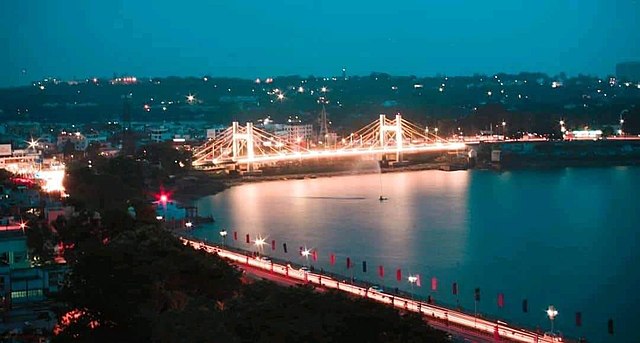
Bhopal is the capital city of Madhya Pradesh, located in central India. Popularly known as the City of Lakes, Bhopal is among the greenest cities in the country and serves as an important administrative, cultural, and educational center.

According to Census 2011, Bhopal had a population of 1,798,218 (17.98 lakh), making it the second most populous city in Madhya Pradesh and the 16th largest city in India at that time.

Based on recent growth trends, the estimated population of Bhopal in 2026 is around 22 lakh (2.2 million), reflecting steady urban expansion.

👉 Projected Population of Bhopal City (2026): ~2.2 Million (22 Lakh)

Census 2011 Details

ParticularsCensus 20112026 Estimate
Total Population1,798,218~22 lakh
Male Population936,168~11.3 lakh
Female Population862,050~10.7 lakh
Literacy Rate83.47%
Sex Ratio921
Child Sex Ratio919
Children (0–6 Years)216,088

Source: Census 2011

📌 Key Takeaways – Bhopal Demographics

  • Bhopal is the capital and second-largest city of Madhya Pradesh.

  • The city recorded 23.30% population growth during 2001–2011.

  • Population density in 2011 was about 3,887 persons per sq. km.

  • Literacy rate stands at 83.47%, indicating strong educational development.

  • Sex ratio of 921 is slightly below the national average.

  • Children (0–6 years) account for about 12.02% of the population.

  • Hinduism and Islam are the two major religions in the city.

Religion in Bhopal

ReligionPercentage
Hinduism69.20%
Islam26.28%
Jainism1.35%
Christianity1.12%
Buddhism1.08%
Others†0.60%

Sources: Census 2011

Bhopal Historical Population

As per Census 2011, Bhopal has a population growth rate of 23.30% during 2001-2011.  It’s expected to have a population growth rate of 14% during 2011-2021.

At the start of the 20th century, the Bhopal population was under one lakh and it don’t show any major growth until the Independence of India.  After the formation of Madhya Pradesh and Bhopal as its capital population saw a steady growth & reached 1 million in 1991 & 2 million in 2021.

Let’s look at population & percentage change from  Year 1901 to 2021.

Census YearPopulationActual ChangePercentage Change
190177,023
191156,204-20,819-27.03%
192145,094-11,110-19.77%
193161,03715,94335.36%
194175,22814,19123.25%
1951102,33327,10536.03%
1961222,948120,615117.87%
1971384,859161,91172.62%
1981671,018286,15974.35%
19911,062,771391,75358.38%
20011,458,416395,64537.23%
20111,798,218339,80223.30%
20212,060,000261,78214.56%

Sources: Census 2011

Bhopal District Population

Bhopal District is a district of Madhya Pradesh state in central India.  The city of Bhopal serves as its administrative headquarters. As per census 2011, Bhopal district population is 2,371,061  (23.71 Lakh)

👉 Estimated population of Bhopal District in 2026 ~ 27 lakh

ParticularsData
Total Population2,371,061
Male Population1,236,130
Female Population1,134,931
District Area2,772 sq. km
Population Density860 per sq. km
Literacy Rate80.37%
Sex Ratio918
Child Sex Ratio920
Bhopal Population 2026 – City & District Census, Growth and Demographics
Rajeev Rana

Rajeev Rana is an independent writer and researcher with a strong interest in history, population studies, and demographic trends in India and North America. He has been writing on demography-related topics for over five years, focusing on census data, migration patterns, ethnicity, and regional population changes. While not a formally certified demographer, Rajeev closely follows official data releases from government sources, census authorities, and reputable research institutions. His work aims to present complex demographic information in a clear, accessible, and neutral manner for readers seeking factual insights and broader context. Rajeev contributes to multiple informational websites and has particular familiarity with demographic and regional trends in the Delhi NCR region. His writing is driven by curiosity, data interpretation, and a commitment to accuracy rather than advocacy or opinion

2 thoughts on “Bhopal Population 2026 – City & District Census, Growth and Demographics

Leave a Reply