Population of Mathura

Mathura is a historic city in the Indian state of Uttar Pradesh. It is located about 145 km southeast of Delhi and about 50 km north of Agra. Mathura lies on the banks of the Yamuna River and is one of the most important religious centers in Hinduism.

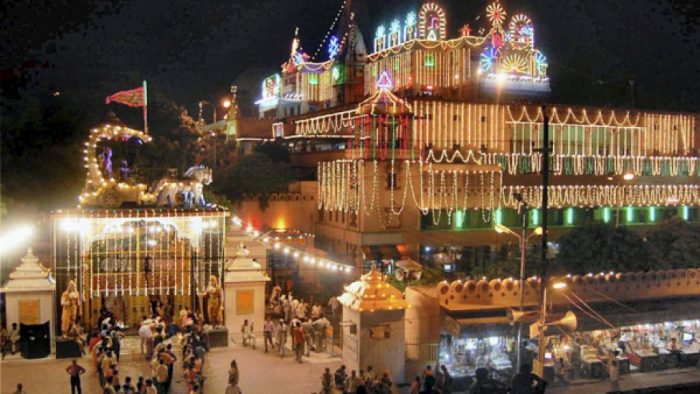
Mathura is widely known as the birthplace of Krishna, and the sacred Krishna Janmasthan Temple Complex marks the location where he is believed to have been born. The city is also counted among the Sapta Puri, making it one of the holiest cities for Hindus. Due to its historical and religious significance, Mathura has been selected as one of India’s heritage cities by the Government of India.

According to the Census of India 2011, the population of Mathura city was 349,909 (3.49 lakh). Based on recent growth trends, the estimated population of Mathura in 2026 is around 4.5 lakh.

👉 Projected Population of Mathura in 2026: ~4.5 lakh

Census Quick Facts

Mathura CityTotalMaleFemale
Population (Census 2011)349,909 (3.49 Lakh)185,983163,926
Children (0–6 years)44,37923,86420,515
Average Literacy Rate74.97%80.40%68.84%
Sex Ratio881
Child Sex Ratio860

Source: Census 2011

Mathura Historical Population

According to Census 2011, Mathura recorded a population growth rate of 15.57% during 2001–2011. With moderate urban expansion and tourism growth, the city is expected to maintain steady population growth in the coming decades.

Below is the historical population trend of Mathura city from 1901 to 2021.

YearPopulationActual ChangePercentage Change
190160,042
191158,183-1,859-3.10%
192152,840-5,343-9.18%
193160,5907,75014.67%
194176,71616,12626.61%
195198,55221,83628.46%
1961116,95918,40718.68%
1971132,02815,06912.88%
1981147,49315,46511.71%
1991226,69179,19853.70%
2001302,77076,07933.56%
2011349,90947,13915.57%
2021 (estimate)400,00050,09114.30%

Sources: Census 2011

Mathura District Population

Mathura district is an important district of western Uttar Pradesh. The city of Mathura serves as the administrative headquarters of the district.

The district is located about 50 km north of Agra, around 11 km from Vrindavan, and about 22 km from Govardhan. During ancient times, Mathura was a major economic and trade hub located on important caravan routes.

According to the 2011 Census, the population of Mathura district was 2,547,184 (25.47 lakh). The district had a population density of about 761 persons per sq. km and recorded a population growth rate of 22.53% between 2001 and 2011.

The sex ratio in the district is around 863 females per 1000 males, while the literacy rate is about 70.36%. Approximately 29.68% of the population lives in urban areas, and Scheduled Castes make up 19.89% of the district population.

👉 Estimated Population of Mathura District in 2026: ~30 lakh

Census Quick Facts

Mathura DistrictCensus 2011
Total Population2,547,184
Male Population1,367,125
Female Population1,180,059
Literacy Rate70.36%
Sex Ratio863
Child Sex Ratio870

Religions in Mathura District

Religion distribution in the district according to the 2011 Census:

ReligionPercentage
Hinduism90.72%
Islam8.52%
Others / Not Stated0.76%

Languages in Mathura District

The main languages spoken in the district are Hindi, Braj Bhasha, and Urdu.

LanguagePercentage
Hindi75.2%
Braj Bhasha22.2%
Urdu0.81%
Others1.74%

Key Takeaways

  • The population of Mathura city was 3.49 lakh in 2011 and is estimated to reach around 5 lakh by 2026.

  • Mathura is located in western Uttar Pradesh, about 145 km from Delhi.

  • The city is believed to be the birthplace of Lord Krishna and is one of the Sapta Puri (seven sacred Hindu cities).

  • Mathura had a literacy rate of about 74.97% in 2011.

  • The district population was about 25.47 lakh in 2011 and is estimated to reach around 30 lakh by 2026.

  • Hinduism is the dominant religion, followed by Islam.

  • The main languages spoken in the district are Hindi, Braj Bhasha, and Urdu.

Note: In many Indian cities, official municipal boundaries cover only the core urban area, so the reported city population may appear smaller than the actual urban population. In such cases, the district population often provides a better reflection of the broader urban region, as Census city limits and Urban Agglomeration (UA) definitions do not always capture the full functional city area.

Mathura Population 2026 : City & District Census, Growth and Demographics

Rajeev Rana

Rajeev Rana is an independent writer and researcher with a strong interest in history, population studies, and demographic trends in India and North America. He has been writing on demography-related topics for over five years, focusing on census data, migration patterns, ethnicity, and regional population changes. While not a formally certified demographer, Rajeev closely follows official data releases from government sources, census authorities, and reputable research institutions. His work aims to present complex demographic information in a clear, accessible, and neutral manner for readers seeking factual insights and broader context. Rajeev contributes to multiple informational websites and has particular familiarity with demographic and regional trends in the Delhi NCR region. His writing is driven by curiosity, data interpretation, and a commitment to accuracy rather than advocacy or opinion