> > India >>  States >>  Kerala

do you want to know How many districts in Kerala / Total district in Kerala ? 

Largest and Smallest District in Kerala

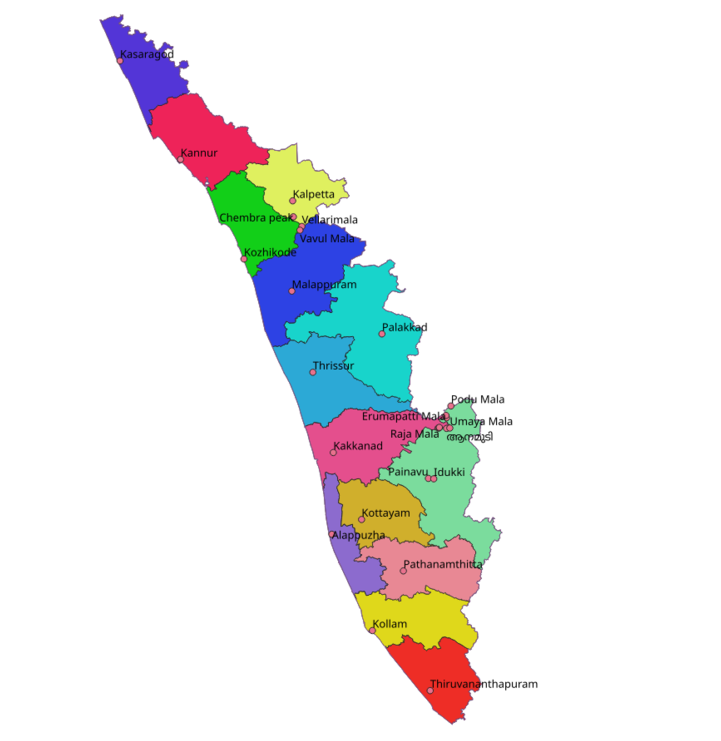
Kerala is a state in southern India. As of 2023, there are a total of 14 districts in Kerala. Malappuram District is the most populated district and Wayanad District is the least populated district in Kerala. Palakkad district is the largest district by area and Alappuzha District is the smallest district in Kerala. On the basis of geographical, historical, and cultural similarities the state’s districts are generally grouped into three parts.

Northern Kerala districts 

  • Kasaragod, Kannur, Wayanad, Kozhikode, and Malappuram

Central Kerala districts

  • Palakkad, Thrissur, and Ernakulam

Southern Kerala districts

  • Idukki, Kottayam, Alappuzha, Pathanamthitta, Kollam, and Thiruvananthapuram.

read about the Population in Kerala 
#DistrictPopulation (2011)Area (km²)Density (people/km²)
1Alappuzha21,27,7891,4151504
2Ernakulam32,82,3883,0631072
3Idukki11,08,9744,356255
4Kannur25,23,0032,961852
5Kasaragod13,07,3751,989657
6Kollam26,35,3752,4831061
7Kottayam19,74,5512,206895
8Kozhikode30,86,2932,3451316
9Malappuram41,12,9203,5541157
10Palakkad28,09,9344,482627
11Pathanamthitta11,97,4122,652452
12Thrissur33,01,4273,0271508
13Thiruvananthapuram31,21,2002,1891031
14Wayanad8,17,4202,130384

read about religion in Kerala

Know about Largest District in Kerala. Smallest District in Kerala by Population and Area

Largest and Smallest District in Kerala by Area

Palakkad district covering an area of 4482 km² is the largest district in Kerala.  Alappuzha District is the smallest district in Kerala with a total area of 1415 km²

# By AreaDistrictArea
LargestPalakkad4482 km²
Smallest Alappuzha1415 km2

 Source: Census 2011

Largest and Smallest District in Kerala by Population

Malappuram District is the most populated district in Kerala. Its Population as per the census 2011 is 41.13 Lakhs  Wayanad District with a population of 8.17 Lakhs is the least populated district in Kerala

# by PopulationDistrictPopulation (Census 2011)
Most PopulatedMalappuram4112920
LeastWayanad817420
Highest and Lowest Population Density

Thrissur District (1508 people per km) has the highest Population density in Kerala. Idukki District with a population density of 255  people per km is the lowest density district in Kerala.

# by DensityDistrictDensity (person/km)
HighestThrissur1508
LeastIdukki255

Source: Census 2011

Kerala Districts by Literacy Rate | Sex Ratio

#DistrictSex RatioLiteracy
1Alappuzha110095.72%
2Ernakulam102795.89%
3Idukki100691.99%
4Kannur113695.10%
5Kasaragod108090.09%
6Kollam111394.09%
7Kottayam103997.21%
8Kozhikode109895.08%
9Malappuram109893.57%
10Palakkad106789.31%
11Pathanamthitta113296.55%
12Thiruvananthapuram108793.02%
13Thrissur110895.08%
14Wayanad103589.03%

Source: Census 2011

Kerala District with Highest and Lowest Literacy rate

Kottayam district has the highest literacy rate in Kerala. Its literacy rate is 97.21%. Wayanad with a literacy rate of 89.03% is the least literate district in Kerala.
 
# by Literacy RateDistrictLiteracy Rate
Most LiterateKottayam97.21%
LeastWayanad89.03%

Source: Census 2011

Kerala District with Highest and Lowest Sex Ratio

Kannur district (1136) has the highest Male-Female Sex ratio in Kerala.  Idukki District (1006) has the lowest male-female sex ratio in Kerala.

# by Sex RatioDistrictSex ratio
(females to 1000 males)
HighestKannur1136 
LowestIdukki1006 

Source: Census 2011

Kerala District Map
Kerala district map
List of Districts in Kerala 2026 | Kerala District Map

Rajeev Rana

Rajeev Rana is an independent writer and researcher with a strong interest in history, population studies, and demographic trends in India and North America. He has been writing on demography-related topics for over five years, focusing on census data, migration patterns, ethnicity, and regional population changes. While not a formally certified demographer, Rajeev closely follows official data releases from government sources, census authorities, and reputable research institutions. His work aims to present complex demographic information in a clear, accessible, and neutral manner for readers seeking factual insights and broader context. Rajeev contributes to multiple informational websites and has particular familiarity with demographic and regional trends in the Delhi NCR region. His writing is driven by curiosity, data interpretation, and a commitment to accuracy rather than advocacy or opinion