Largest and Smallest District in Delhi

Delhi, the capital territory of India, holds a unique and central position in the country’s political, cultural, and economic landscape. As a Union Territory, Delhi is distinctively governed, serving as the seat of the nation’s government and hosting a diverse population that mirrors the multicultural fabric of India. As of the latest available information in 2024, Delhi is administratively divided into 11 districts, each playing a crucial role in the governance, development, and day-to-day life of its residents.

also read about the Population of Delhi

Delhi, the capital territory of India, holds a unique and central position in the country’s political, cultural, and economic landscape. As a Union Territory, Delhi is distinctively governed, serving as the seat of the nation’s government and hosting a diverse population that mirrors the multicultural fabric of India. As of the latest available information in 2024, Delhi is administratively divided into 11 districts, each playing a crucial role in the governance, development, and day-to-day life of its residents.

#DistrictPopulation (2011)Area (km²)Density (/km²)
1Central Delhi5,82,3202527,730
2East Delhi17,09,3466427,132
3New Delhi1,42,004224,057
4North Delhi8,87,9785914,557
5North East Delhi22,41,6245236,155
6North West Delhi36,56,5391308,254
7Shahdara –59.75 –
8South Delhi27,31,92925011,060
9South East Delhi 333 
10South West Delhi22,92,9584205,446
11West Delhi25,43,24311219,563

Source: Census 2011

*South East & Shahdra district was created after 2011 Census, independent data not available yet.
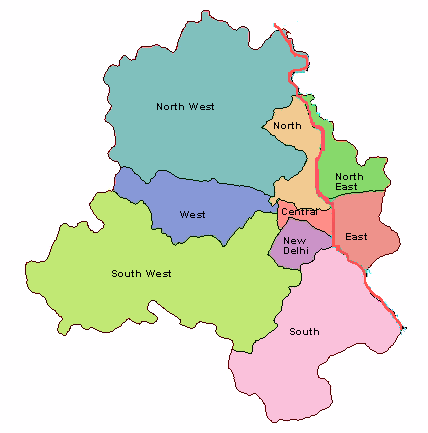
Delhi District Map

Delhi district map

Largest and Smallest District in Delhi by Area

South West Delhi district covering an area of 420 km² is the largest district in Delhi. New Delhi District is the smallest district in Delhi of with a total area of 22 km²

# By AreaDistrictArea
LargestSouth West Delhi420 km²
Smallest New Delhi 22 km2

 Source: Census 2011

Largest and Smallest District in Delhi by Population

North West Delhi District is the most populated district in Delhi. Its Population as per census 2011 is 36.56 Lakhs,  New Delhi District with a population of 142,004 is the least populated district in Delhi.

# by PopulationDistrictPopulation (Census 2011)
Most PopulatedNorth West Delhi3,656,539
LeastNew Delhi142,004
Highest and Lowest Population Density

North East District ( 36155 people per km) has the highest Population density in Delhi. New Delhi District with a population density of 4057  people per km is the lowest density district in Delhi.

# by DensityDistrictDensity (person/km)
HighestNorth East Delhi36155
LeastNew Delhi4057

Source: Census 2011

Delhi District by Literacy rate | Sex Ratio

#DistrictSex RatioLiteracy
1Central Delhi89285.14%
2East Delhi88489.31%
3New Delhi82288.34%
4North Delhi86986.85%
5North East Delhi88683.09%
6North West Delhi86584.45%
7Shahdara  
8South Delhi86286.57%
9South East Delhi  
10South West Delhi84088.28%
11West Delhi87586.98%
 Source: Census 2011
 
*South East & Shahdra district was created after 2011 Census, independent data not available yet.

Delhi District with Highest and Lowest Literacy rate

East Delhi district has the highest literacy rate in Delhi. Its literacy rate is 89.31%. North East Delhi with a literacy rate of 83.09% is the least literate district in Delhi
 
# by Literacy RateDistrictLiteracy Rate
Most LiterateEast Delhi89.31%
LeastNorth East Delhi83.09%

Source: Census 2011

Delhi District with Highest and Lowest Male Female Ratio

Central district (892) has the highest Male-Female Sex ratio in Delhi.  New Delhi District (822) has the lowest male-female sex ratio in Delhi

# by Sex RatioDistrictSex ratio
HighestCentral892 females to 1000 males
LowestNew Delhi822 females to 1000 males

Source: Census 2011

Delhi District Map
Delhi district map

Read more about Delhi

List of Districts in Delhi 2026 | Delhi District Map

Rajeev Rana

Rajeev Rana is an independent writer and researcher with a strong interest in history, population studies, and demographic trends in India and North America. He has been writing on demography-related topics for over five years, focusing on census data, migration patterns, ethnicity, and regional population changes. While not a formally certified demographer, Rajeev closely follows official data releases from government sources, census authorities, and reputable research institutions. His work aims to present complex demographic information in a clear, accessible, and neutral manner for readers seeking factual insights and broader context. Rajeev contributes to multiple informational websites and has particular familiarity with demographic and regional trends in the Delhi NCR region. His writing is driven by curiosity, data interpretation, and a commitment to accuracy rather than advocacy or opinion